
Nerve Health
Neuropathy Leg Cramps at Night: Why Your Calf Locks Up at 3 a.m. and Won't Let Go
Bananas, pickle juice, tonic water, the drugstore magnesium. If you have tried them all and still wake up with your calf in a fist, the problem may not be the muscle at all.
By the HealthVital editorial team · 8 min read
Neuropathy leg cramps at night have a way of arriving at the worst possible hour. You are sound asleep, your foot points on its own, and a second later your calf is a hard knot that will not let go. You are out of bed, standing on a cold floor, pushing your heel down and waiting for it to pass.
Maureen, 66, a retired school secretary from Ohio, described it to us in one sentence: "It feels like someone grabbed my calf with a pair of pliers and forgot to let go." For almost two years, that happened three or four nights a week. Her neuropathy had started as tingling in her toes. The cramps came later, and they were worse.

"The worst part wasn't the pain," she told us. "It was going to bed scared. I would lie there with my feet flexed up, trying not to point my toes, waiting for it."
If you recognize yourself in that, keep reading. There is a reason the cramps get worse as the nerve trouble goes on, and it is the part almost nobody explains.
Why neuropathy and night leg cramps keep showing up together
A neuropathy clinic's guide published just this week lays out what many people never hear in a ten-minute appointment: peripheral neuropathy can be linked to cramping in the feet and calves, but it is not always the cause. Dehydration, muscle fatigue, poor circulation, metabolic problems and certain medications can all play a part, and sometimes more than one is going on at once.
That last sentence is the important one. When the nerve is part of the story, the usual muscle fixes tend to help a little and then stop helping. Here is how people with nerve-related night cramps usually describe it:
- The cramps hit mostly at night, often in the same calf or the arch of the same foot
- Your feet also tingle, burn, or feel numb during the day
- After a cramp, the muscle stays sore and "bruised" into the next afternoon
- Toes curl or the arch locks when you stretch out in bed or point your foot
- You have changed what you drink and eat, and the cramps keep coming back
If three or more of those sound like your nights, the muscle may be the one doing the shouting, but the nerve may be the one giving the orders.
Everything Maureen tried, and why each one only half worked
Maureen did what everyone does. A banana before bed for the potassium. A shot glass of pickle juice on the nightstand, because a neighbor swore by it. A glass of tonic water at dinner, until her pharmacist told her the FDA has warned against using quinine for leg cramps because of its risks. Calf stretches against the bedroom wall every night. Compression socks during the day.
And, of course, the big bottle of magnesium from the drugstore. "That one did something," she said. "It also sent me running to the bathroom. Some weeks the cramps were a little better and my stomach was a lot worse."
Every one of those things can help some people. The stretching is genuinely worth doing. But notice what they all have in common: they all treat the cramp as a muscle problem. Feed the muscle, stretch the muscle, rub the muscle.
When the nerve that controls the muscle is the one misbehaving, you can do all of that perfectly and still wake up at 3 a.m. with your calf in a fist.
The switch that forgets how to turn off
Here is the simplest way we can put it. A muscle does not decide to tighten on its own. A nerve tells it to. And just as important, a nerve has to tell it to let go.
That "let go" step is the one that fails in a cramp. The tightening signal fires, and the release never comes through. Three things make that release step work, and in people with nerve trouble in the legs, all three tend to run low at the same time:
The calming mineral. Nerves and muscles use magnesium to settle back down after they fire. Without enough of it where it is needed, the nerve stays twitchy and quick on the trigger. The catch is the form: the cheap kind in most drugstore bottles is poorly absorbed, and a lot of it simply runs straight through you. That is exactly what Maureen's stomach was telling her.
The fuel at the far end. The nerves that reach your calves and feet are some of the longest cells in your body. Keeping a line that long working takes a lot of energy, and the end farthest from your spine is the first to run short. A tired nerve does not send clean signals. It misfires.
The night-time slowdown. When you lie still for hours, circulation in the lower legs slows down. Whatever the nerve needs has a harder time getting there, right at the hours when the cramps hit.
That is why the 3 a.m. timing is not a coincidence. And it is why a single fix aimed at one of those three, a mineral here or a stretch there, so often helps for a week and then fades.
Maureen did not figure this out from a doctor. She figured it out from her brother-in-law, at a cookout, holding a paper plate.
The brother-in-law who stopped sleeping in the recliner
Her sister's husband, Gary, 64, has had nerve trouble in his feet for years, tied to his blood sugar. For a long stretch he slept in the recliner in the den because, as he put it, "if my legs are bent, they don't knot up as much." Maureen's sister had complained about it at every family dinner.

At the Labor Day cookout, Maureen noticed he had walked down to the lake and back without limping. When she asked, he did not give her a speech. He said, "I'm sleeping in a bed again," and told her what he had been taking since the spring.
Maureen's honest reaction: "I thought, here we go. Another bottle." She had a cabinet full of them. But Gary was the most skeptical man she knew. He reads the fine print on his car insurance. If he was taking something every morning, she figured it was worth reading the label.
So she did, that night, at her kitchen table, with her reading glasses and the photo Gary texted her. The first line on the Supplement Facts panel was magnesium, and next to it, in parentheses, the word she had been missing: glycinate, the gentle, well-absorbed form. Under that she found something for the fuel and something for the circulation in the legs. One capsule a day. And a 60-day satisfaction promise.
"That's what got me," Maureen said. "Sixty days. If it didn't work, I'd know, and I'd get my money back. I had already wasted more than that on pickle juice and bananas."
The bottle was Quiet Nerves.
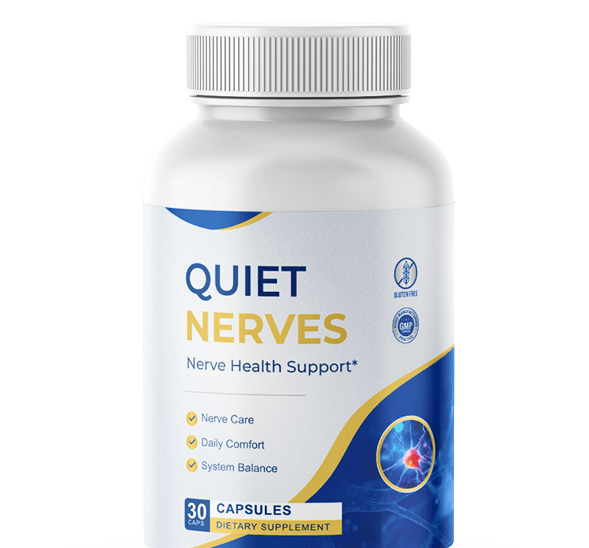
What is inside, and how each piece lines up with the 3 a.m. cramp
These are the ingredients listed on the Quiet Nerves label and product page. Maureen went through them one by one, matching each to the three things the release step needs:
- Magnesium glycinate (80 mg of magnesium per capsule). The calming mineral, in the form that is known for being gentle and well absorbed. The company calls it the cornerstone of the formula, for nerve signaling and muscle relaxation, and notes it is also associated with calm and restful sleep. For Maureen, this was the line that mattered most.
- L-carnitine and coenzyme Q10. The fuel. Both help cells make energy, and the product page points out that the body makes less of each as we age, with the nerves in the hands, feet and legs among the first to feel it.
- Butcher's broom root extract. A traditional European plant used to support healthy circulation, particularly in the lower limbs. This is the piece for the night-time slowdown.
- Alpha lipoic acid and turmeric extract (95% curcuminoids). Antioxidant and inflammation support for nerves that have been irritated for a long time, so they are not so quick to misfire.
The magnesium plus the other five come in a 575 mg blend, one vegetable capsule, 30 capsules to a bottle. It is made in an FDA-registered, GMP-certified facility, and it is gluten-free and non-habit forming, according to the company.
How Maureen takes it
One capsule a day, with a meal and a full glass of water, which is what the company recommends. Maureen takes hers with breakfast. She kept doing her calf stretches at night, and she showed the label to her doctor first, since she is on a blood pressure pill. That is a step we would ask anyone on prescriptions to take.
What changed, and when
- Week 1. Nothing dramatic. Two cramps that week, about her usual. What she did notice was that the stomach trouble from the drugstore magnesium was gone.
- Weeks 2 to 3. "I had a cramp start, and it let go on its own before I got my feet on the floor. That had never happened." She wrote the date on her kitchen calendar.
- Month 1. Cramps down to about one night a week, and shorter. She stopped lying in bed with her feet flexed, bracing for one.
- Months 2 to 3. Most weeks, none. The leftover soreness in the calf the next afternoon, which she had come to think of as normal, was mostly gone. Her daytime tingling was quieter too, though not gone.
Why weeks and not days? Because this is not a painkiller. You are not numbing the cramp, you are giving a tired, irritated nerve what it needs to settle down, and a nerve that long changes slowly. The company says many people notice a difference within the first two to four weeks of steady use. In our experience with readers, the ones who give up after ten days are the ones who never find out. That is why Maureen's second order was the larger supply, so she would not run out in the middle of month two. Results vary from person to person, and some people take longer.
If your calf has been waking you up at 3 a.m., this is the bottle on Maureen's nightstand.
See the formula Maureen takes →Who this may help, and who should not wait on it
It may be worth trying if you are over 50, you have nerve trouble in your feet or legs, your cramps come mostly at night, you have already tried the bananas, the stretching and the drugstore magnesium, and they helped for a while and then stopped.
Do not use this instead of a doctor if your cramps come with real weakness in the leg, shrinking muscle, swelling or redness in one calf, a leg that turns pale or cold, or numbness that came on suddenly. The clinic guide we mentioned says the same thing: persistent cramping with weakness, muscle loss, swelling or circulation symptoms deserves a proper evaluation. A swollen, painful calf in particular can be a blood clot, and that needs care the same day. If you are pregnant or nursing, or you take several prescriptions, show the label to your doctor before you start.
The promise that let Maureen say yes
The Quiet Nerves order page shows a 60-day satisfaction promise from the original purchase date. If you are not satisfied, you contact the company through its contact page within those 60 days and they make it right. For Maureen, that turned the decision into something small: "Two months of honest nights. Either the cramps change or I get my money back. I wasn't going to lose anything but the cramps."
Sixty days, one capsule with breakfast, and your money back if your nights don't change.
Start my 60 days with Quiet Nerves →Whatever you decide, try one small thing tonight: before bed, sit on the edge of the mattress and gently pull your toes up toward your shin for thirty seconds on each side, and keep a glass of water where you can reach it. It will not fix the nerve, but it is a better way to end the day than lying there waiting for the knot.
P.S. Maureen still keeps a glass of water on the nightstand. These days she drinks it in the morning, after a full night's sleep, instead of at 3 a.m. standing on a cold floor. If your calves are still running your nights, read the page Maureen read at her kitchen table.
Individual results vary. Testimonials reflect personal experiences; names changed for privacy. This is an advertisement and not a news article.